


Patients are now looking closely at what they consume medically, whether it be vaccines, medications or supplements. Psychiatry may be one of the first places a person brings this attention because we are talking about treatments that affect the way we think! At Mirror Health Clinic, we are all about maximizing lifestyle and therapy to take only what is needed. With that in mind, what does stopping psychiatric medication look like? There are a few key concepts that are worth knowing. Keep in mind, this is not medical advice, this article does not establish a provider-patient relationship, and you should consult your prescriber, hopefully from a now more informed perspective.
Why Stop Medication
It is worth explicitly stating the purpose of stopping, which typically falls into one of the following categories
1) There’s an intolerable side effect
2) The risks outweigh the benefits
3) Benefits have faded over time (not uncommon after years on a psychotropic)
4) You’re feeling stable and hoping to lower or stop a medicine
Naming “why” isn’t just paperwork, it shapes the how. An intolerable side effect might justify coming off more quickly, while a stable patient hoping to simplify their regimen can afford to go slow. Being clear about the purpose upfront helps guide the decisions that follow.
Half Life
Some medication is short acting while others long acting. This is usually defined by “half-life” or how long it takes your body to remove half of the medication. There are some medications that have a long half life such as Fluoxetine (Prozac) that can be tapered quickly because the body naturally removes it slowly. Whereas a drug such as Venlafaxine (Effexor) has a short half-life and must be intentionally slowly tapered.
Cross Tapering
One strategy that can help decrease the chance of withdrawal symptoms is a cross taper. Cross Tapering involves starting one medication at the same time as decreasing another. Think of the long half-life Fluoxetine being started while Venlafaxine is being stopped.

Class of Medication and Withdrawal Syndromes
For antidepressants, stopping the medication can make a person feel irritable / depressed, sick or flu like, dizzy, have trouble with sleep, “brain zaps” among other symptoms.
For benzodiazepines, stopping the medication can be life threatening! Often this leads to a longer duration taper, paced by the clinical guidance of a provider.
Elderly, pregnant, or breast feeding patients have unique considerations when stopping medication.
There are other classes of psychotropic medication with varied withdrawal syndromes. To list all of those is beyond the scope of this post.
Withdrawal vs Recurrence of Symptoms
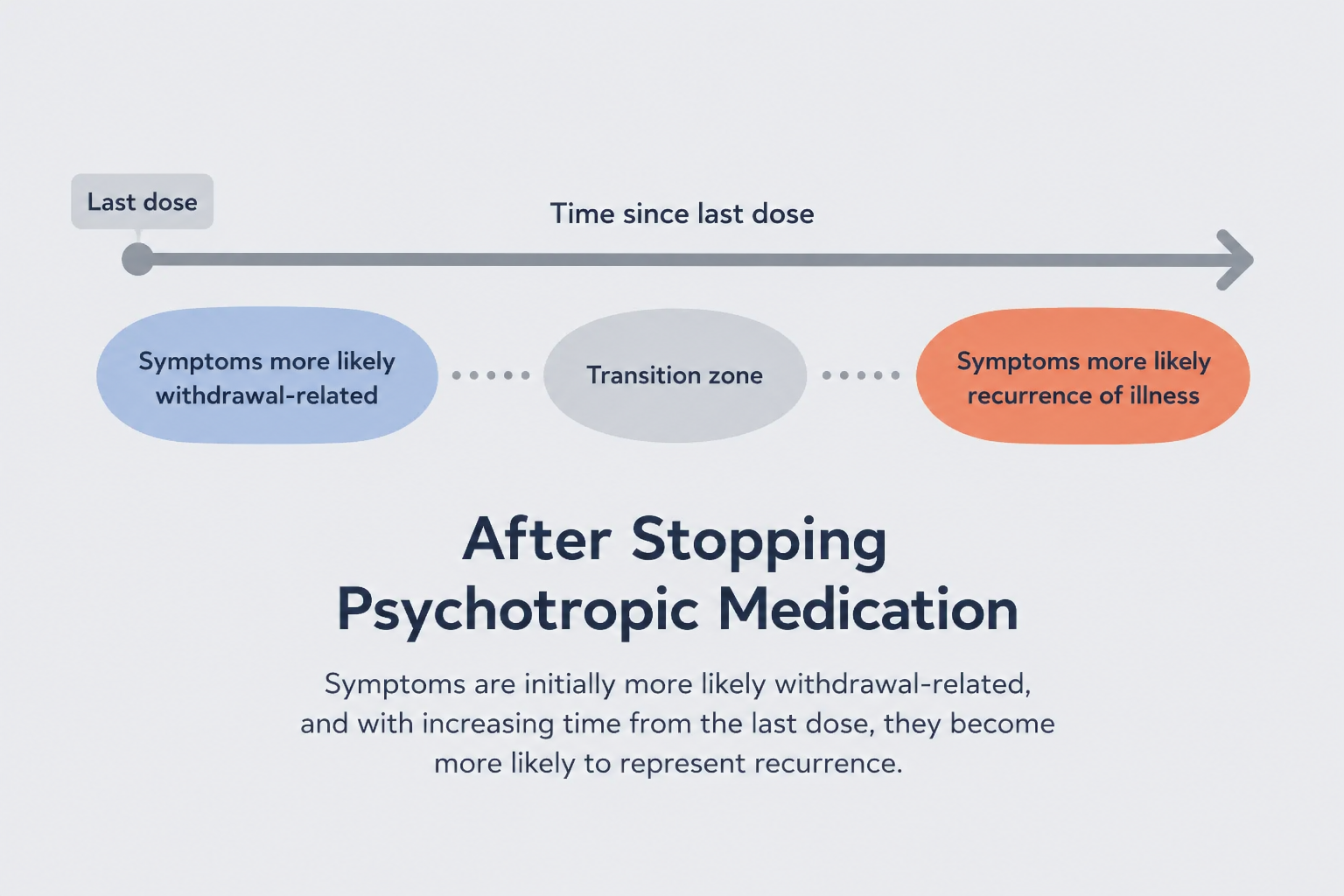
There are prolonged withdrawal syndromes but that is a complex topic, is not common, and beyond the scope of this post.
A Common Taper Schedule
If a patient has been on a medication for greater than three months of time, reducing the total dose by approximately 25% every two weeks is a reasonable strategy. There is a lot of nuance to what works best for each patient and regarding what medication.
Practical Tips
1) Begin tapering when you have felt stable for some time and stress is low. I don’t often start deprescribing in the middle of an Ohio winter for example
2) Optimize your diet / exercise / supplement routine to buffer potential withdrawal symptoms
3) Have a stated plan with your prescriber, know what withdrawal symptoms to look for and be able to check in through messaging or appointments. I will encourage my patients to message me a few days after a change just to keep me updated with how things are going.
4) Consider cross-tapering
5) Be honest with yourself and your prescriber regarding your tolerance for discomfort / withdrawal symptoms. If you have no side effects currently and a low tolerance for side effects, lean toward a slow taper.
6) Be willing to adjust based on new information. Some patients simply do better with some medication, and we agree that now might not be the best time to move to zero medicine. This is not an easy conversation to have but one that might save a serious episode from occurring down the road.
7) The last part of a taper can be the most difficult. Depending on the medication, some forms allow for more precise decreases such as liquid form.
8) Track how you are doing! Some patients feel their symptoms so strongly in the moment that it is difficult to see change. I’ll often ask my patients to document their mood and anxiety but also how they are functioning. Some patients have significant symptoms remain and voice this to me saying, “the medication is not working”. But when you look at their life, they are back to work / school, not isolating themselves, and have improved their diet / exercise routine.
Conclusion
I hope this blog post has equipped you to better discuss deprescribing with your clinician. The impact of stopping a medication can range from “ok to cold turkey” all the way to being life threatening. So please do not undertake tapering off medication on your own.
Dr. Justin Hendricks MD