


One of my biggest surprises and challenges since becoming a private practice psychiatrist is scrupulosity and OCD. There is an overlap of concepts, symptoms and treatments that would benefit from explanation. Nothing said here is meant to explicitly diagnose or treat OCD / scrupulosity. Please consult with a spiritual advisor and/or mental health provider.
Prediction Error
Think of a hunter who is looking for a deer in the woods. He clears his mind of all things but what he sees and hears. And with these two senses he looks for change. His mind projects a wooded environment without a deer and looks / listens for indications of a deer. Our minds predict our environments constantly. When you make a drive that you’ve driven many times before, you can be lost in thought until something novel occurs. Your brain does not passively take in sensory information. No, it is actively predicting where things are, how you should feel, what comes next, and what you should be doing. Our brains predict our experience and adjust along the way.
In OCD, prediction error does not shut off properly. For example, if I expect the garage door to be closed at night but happen to see that it is open, I close the garage door and the warning system ends. In OCD, the prediction error is not extinguished. The garage door is shut the first time but then the concern for it being open lingers. This anxiety feels significant and is relieved from compulsive checking.
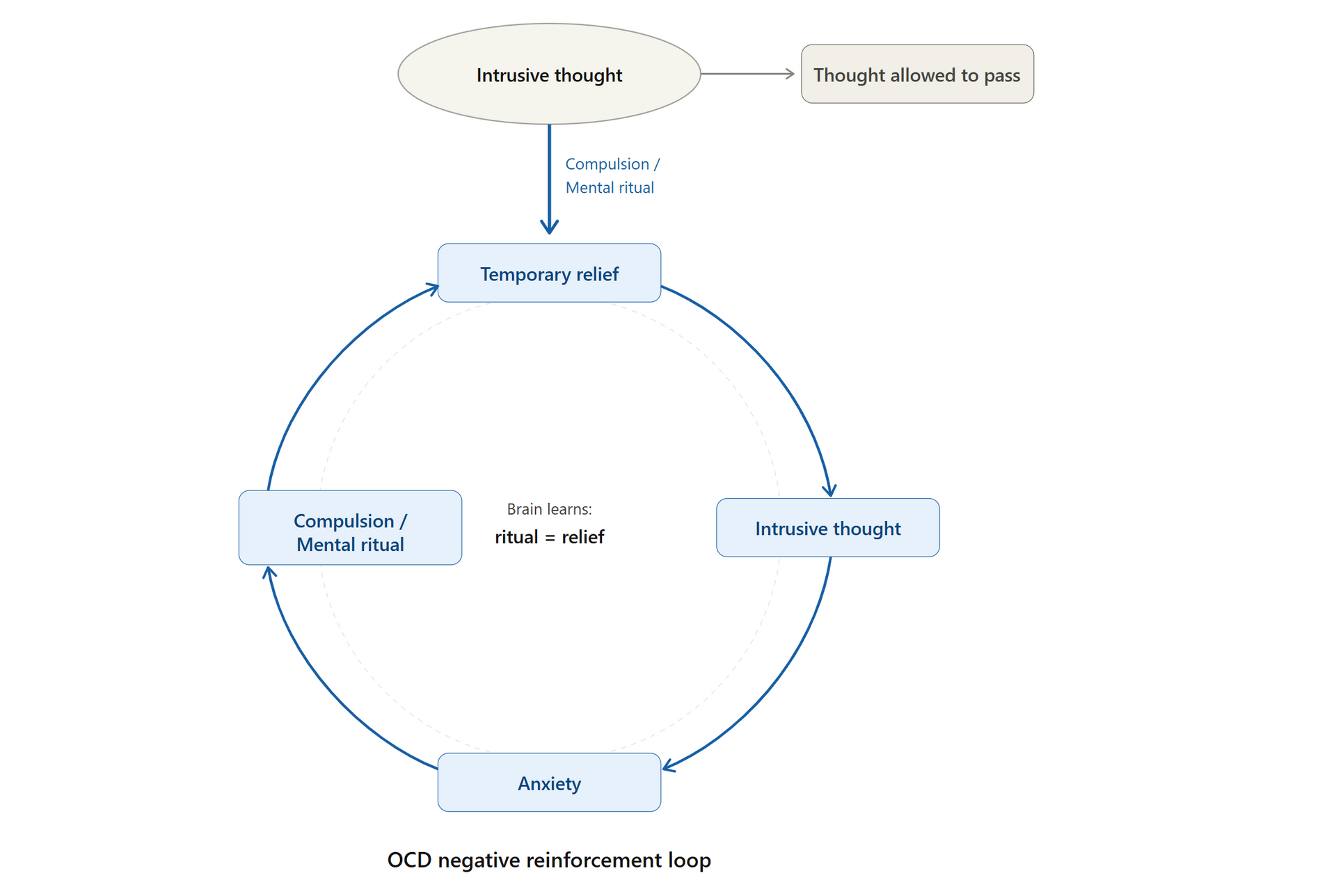
In a sense, the alarm is only quieted, not turned off.
This sequence is so distressing that people with OCD begin to predict the prediction error. Now the alarm is not only hard to shut off but it activates too easily. Think of a fire alarm that activates when someone is cooking and only quiets down after a particular ritual. The brain learns that ritual = relief.
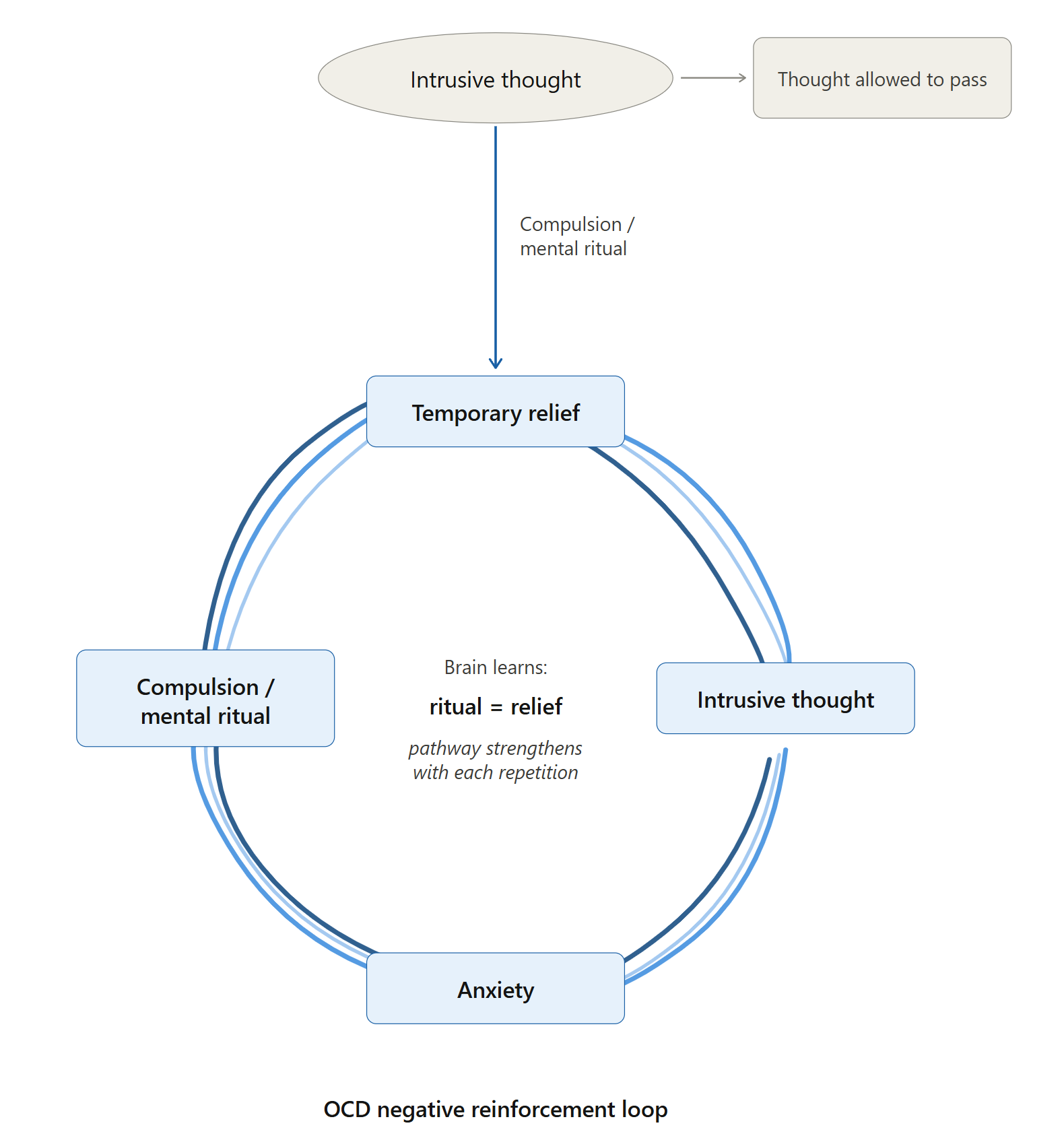
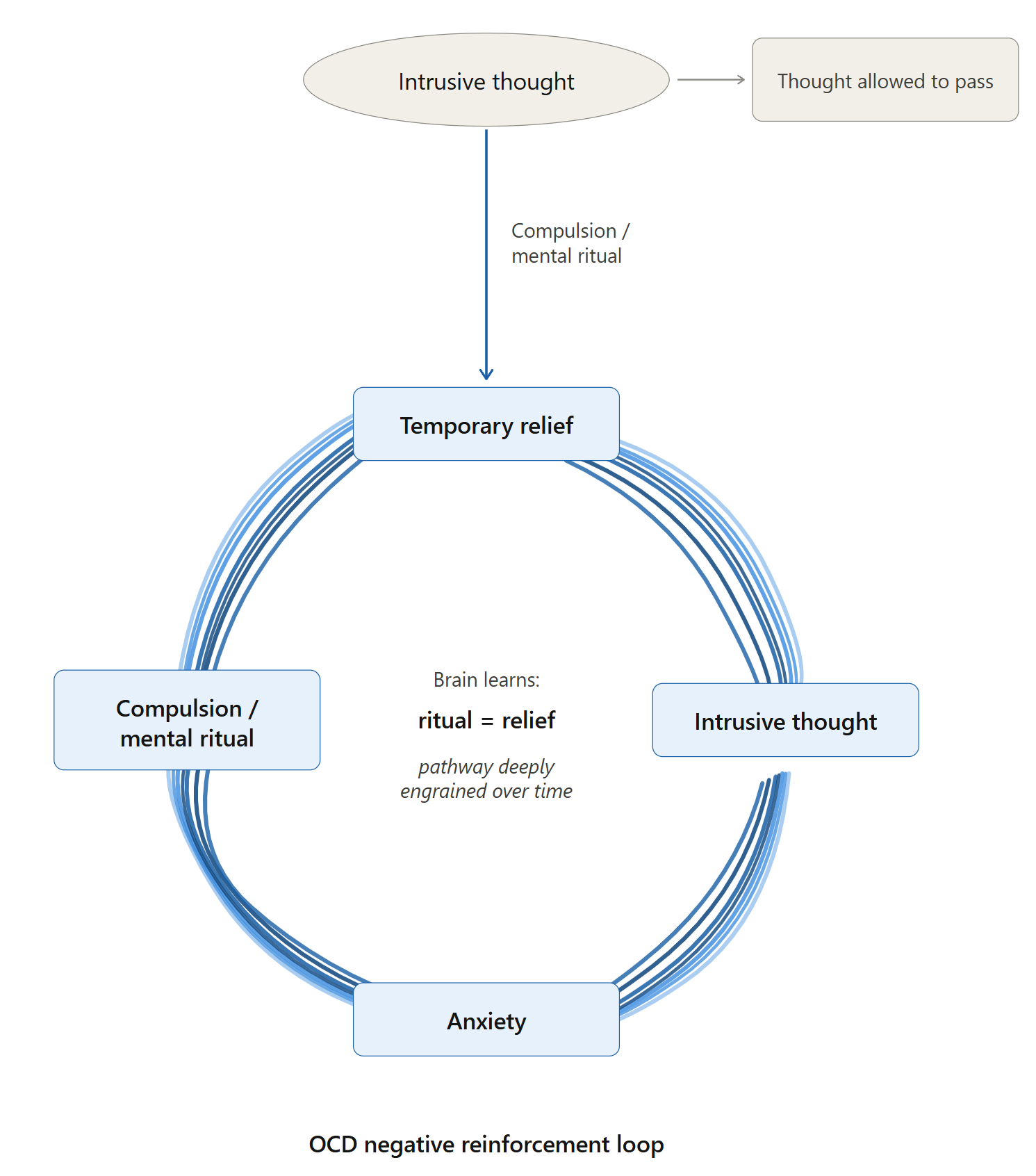
And then the thought loop thickens over time. Sometimes my patients and I call this, “solving the puzzle”. The problem is, the puzzle cannot be solved.
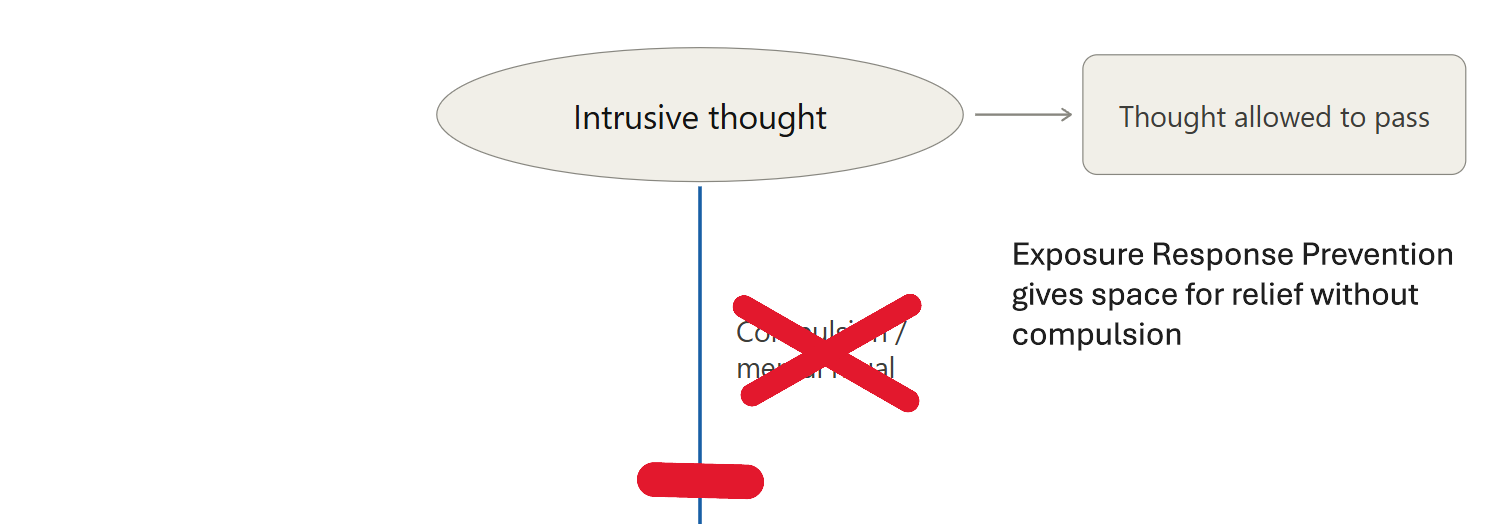
Exposure Response Prevention seeks to uncouple the “intrusive thought” from the circle. That gives space for the thought to pass without the feared outcome occurring. Now the intrusive thought is uncoupled from the ritual, there is an alternative pathway to relief.
Moral Failing
For persons of faith, moral failings can be totally catastrophic. Beyond all earthly consequences, the loss of grace for one's soul is severely distressing.
Sexual Impropriety
Intrusive thoughts surrounding sex can overlap with moral failing. A person questions the origin of the thought and wonders if they may act on them. What would others think if they knew of the thought (social rejection)?
Symmetry
The brain predicts that things should feel “right” – even, ordered, balanced – and when they don’t, a sense of wrongness persists that can’t be reasoned away. While there might not be the classic “fear” associated with other OCD types, there is a compulsion to order that brings temporary relief.
Checking / Contamination / Physical Harm
Checking the door is locked or oven off
Washing hands to avoid infection
Ensuring you haven’t hit someone with your car
The link between fear and association with survival is evident with these subtypes. In practice, I have seen these behaviors as able to be quantified (how much time spent on compulsion) as well as being responsive to medication. The straight forward nature of the fear and compulsion lend themselves to treatment whereas other OCD types can be convoluted in relation to a person's ego or sense of self.
Social Rejection
Social rejection used to have profound implications for a person. When our social circles were limited and local, discord within a group might have meant removal. Removal might have meant death. Our situation now is much different. Our social circle is not local, limited, and subsistence is not dependent on social standing. But this sensitivity to social position persists in many people. For a person with OCD, social rejection often intensifies the guilt and shame surrounding their symptoms.
Somatic
Somatic OCD involves a hyperawareness of bodily functions – breathing, swallowing, blinking, heartbeat. What would normally be automatic becomes conscious. The conscious behavior then becomes part of the obsession and compulsion.
The Scrupulous Patient
Scrupulosity is a subtype of OCD in which intrusive thoughts revolve around moral or religious failure. The obsessions center on sin, spiritual worthiness, or violating one’s moral code. The compulsions typically involve prayer, confession, or reassurance seeking.
A few things that make scrupulosity difficult:
- Distinguishing what is sin, venial sin, or mortal sin is difficult to discern
- What is healthy repentance versus compulsions
- Many subtypes of OCD overlap in Scrupulosity
Often the most difficult with Scrupulosity is the question of primary mental health concern vs spiritual attack. Separating symptoms cleanly between the two is almost impossible and they often co-exist. A spiritual matter may have a mental health component and vice versa. So what we are left with is the understanding that engaging in compulsive behavior strengthens the loop of compulsion for temporary relief. Exposure Response Prevention and medication give the mind space to let the thought pass naturally. Over time, the person learns that distressing thoughts can resolve on their own – and that the feared outcome, more often than not, does not occur.
But this subject is nuanced and complex. Every patient feels they have this specific loop and the time where they experience relief, it feels solved. But then it recurs. Often a three pronged approach is required for treatment of Scrupulosity
1. Spiritual Advisor to discern for when confessing is appropriate vs compulsion and need for specific prayer
2. Therapist for Exposure Response Prevention work
3. Psychiatrist for medication management to reduce symptoms which can allow for therapy and spiritual advisement.
Conclusion
I hope you found this helpful. OCD and Scrupulosity affect some wonderful people, and the cycle of symptoms can pervasively impact every aspect of daily life. My hope is that this post provided a basic understanding of OCD, scrupulosity, and the importance of seeking the right treatment. Thank you for taking the time to read.
Dr. Justin Hendricks MD